
Research question
How do oxygen and sulfur change the framework of Zr-based halide electrolytes and accelerate lithium-ion transport?
Key result
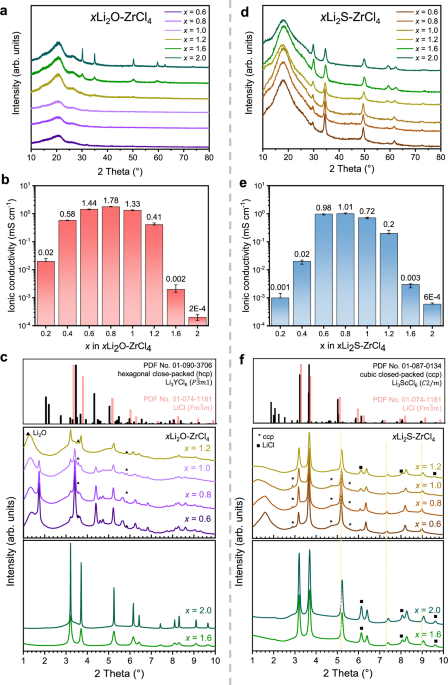
Divalent-anion clustering distorts the framework and changes Li–Cl bonding, reducing the barriers to lithium migration. Oxygen- and sulfur-containing compositions reached 1.78 and 1.01 mS cm⁻¹ at 25 °C, respectively.
Research contribution
Jae-Seung Kim and Dong-Hwa Seo designed the study. The group combined synthesis, electrochemical measurements and first-principles calculations to explain the transport mechanism, working with collaborators on structural characterization.
Impact Factor 18.1 · Top 5.4%
- Best-ranked category
- Multidisciplinary Sciences
- JCR rank
- 8 / 140 journals · Top 5.4%
Citation details & BibTeX
@article{pub1262025,
  title = {{Divalent Anion-Driven Framework Regulation in Zr-Based Halide Solid Electrolytes for All-Solid-State Batteries}},
  author = {Kim, Jae-Seung and Han, Daseul and Choe, Jinyeong and Kim, Youngkyung and Kim, Hae-Yong and Lee, Soeul and Seo, Jiwon and Ham, Seung-Hui and Song, You-Yeob and Lee, Chang-Dae and Lee, Juho and Kwak, Hiram and Kim, Jinsoo and Jung, Yoon Seok and Jung, Sung-Kyun and Nam, Kyung-Wan and Seo, Dong-Hwa},
  journal = {Nature Communications},
  year = {2025},
  volume = {16},
  number = {1},
  eid = {10678},
  doi = {10.1038/s41467-025-65702-2},
  url = {https://doi.org/10.1038/s41467-025-65702-2}
}