
Research question
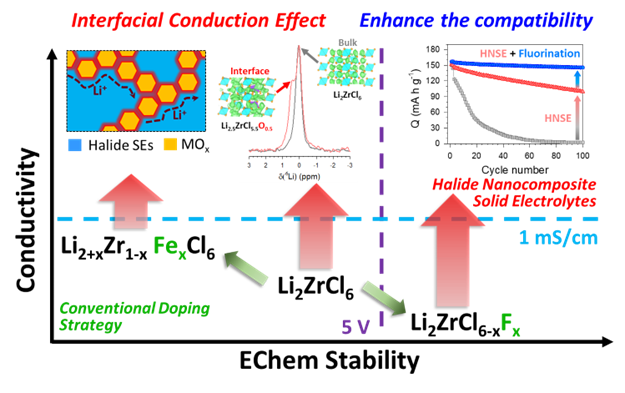
Can interfaces in low-cost zirconium-based halide composites provide faster ion transport while improving compatibility with other battery components?
Key result
Oxide–halide nanocomposites increased lithium-ion conductivity from 0.40 to 1.3 mS cm⁻¹ at 30 °C. Oxygen substitution at the interfaces explained the enhancement; fluorination also improved high-voltage and interfacial stability.
Research contribution
Jae-Seung Kim and Dong-Hwa Seo performed the theoretical calculations that explained enhanced interfacial transport. The calculations complemented synthesis, spectroscopy and cell testing by the collaborating teams.
Impact Factor 18.1 · Top 5.4%
- Best-ranked category
- Multidisciplinary Sciences
- JCR rank
- 8 / 140 journals · Top 5.4%
Citation details & BibTeX
@article{pub852023,
  title = {{Boosting the interfacial superionic conductivity of halide solid electrolytes for all-solid-state batteries}},
  author = {Kwak, Hiram and Kim, Jae-Seung and Han, Daseul and Kim, Jong Seok and Park, Juhyoun and Kwon, Gihan and Bak, Seong-Min and Heo, Unseon and Park, Changhyun and Lee, Hyun-Wook and Nam, Kyung-Wan and Seo, Dong-Hwa and Jung, Yoon Seok},
  journal = {Nature Communications},
  year = {2023},
  volume = {14},
  number = {1},
  eid = {2459},
  doi = {10.1038/s41467-023-38037-z},
  url = {https://doi.org/10.1038/s41467-023-38037-z}
}