
Research question
Can rapid Joule heating shorten DRX synthesis while preserving the structural features needed for high-rate battery operation?
Key result
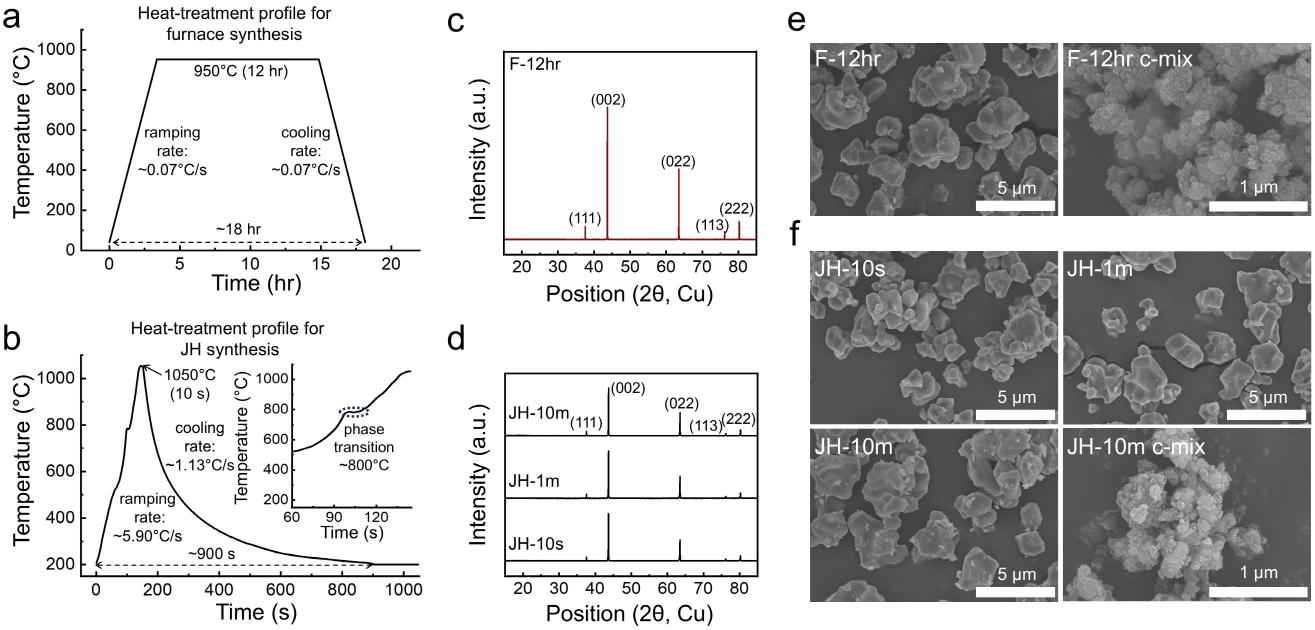
Ten-minute annealing at 1050 °C produced a nearly phase-pure, compositionally uniform DRX cathode with reduced short-range order. It delivered 161 mAh g⁻¹ at 1 A g⁻¹, compared with 137 mAh g⁻¹ for the furnace-synthesized material.
Research contribution
Sang-Wook Park and Hojoon Kim carried out the experiments and interpreted the results. Dong-Hwa Seo co-planned and co-supervised the study with Kisuk Kang, connecting synthesis conditions, multiscale structure and electrochemical performance.
Impact Factor 25.5 · Top 2.4%
- Best-ranked category
- Energy & Fuels
- JCR rank
- 5 / 191 journals · Top 2.4%
Citation details & BibTeX
@article{pub1272025,
  title = {{High-Throughput Synthesis of Mn-Based Disordered Rock-Salt Li-Ion Cathodes with Improved Rate Capability via Rapid Joule-Heating}},
  author = {Park, Sang-Wook and Kim, Hojoon and Han, Sangwook and Kim, Kyoung Sun and Song, You-Yeob and Lee, Hyun-Gi and Jang, Wonyoung and Lee, Dae-Hyung and Bae, Seongjae and Kim, Dongwoo and Park, Jungwoo and Park, Inchul and Nam, Sang-Cheol and Kim, Hyungsub and Lee, Jinhyuk and Kang, Kisuk and Seo, Dong-Hwa},
  journal = {Advanced Energy Materials},
  year = {2025},
  volume = {15},
  number = {48},
  eid = {e03496},
  doi = {10.1002/aenm.202503496},
  url = {https://doi.org/10.1002/aenm.202503496}
}